in the kitchen

in the kitchen
Showing posts with label Austrian. Show all posts

Wednesday, March 6, 2013

Pork Schnitzel

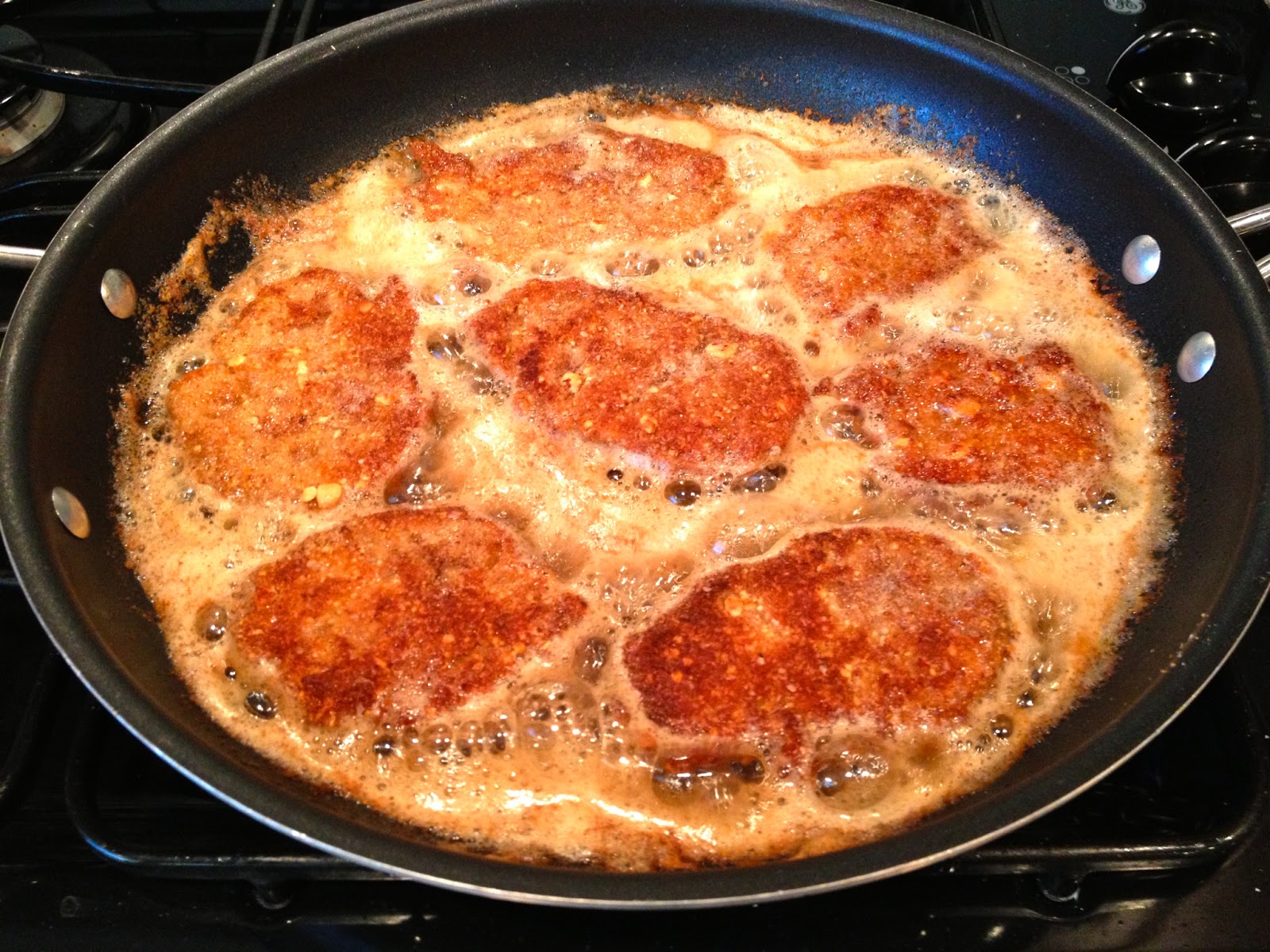
Well, it is time for the drawing! The four aprons will be given away soon. The winners will be posted tomorrow. I hope whoever wins needs a nice apron. Today I want to share a wonderful main dish that is easy and elegant--pork schnitzel. I added ground almonds to the breading, cooked it in real butter and had some lingon berry preserves to serve with it. Ahhh! Just lovely!
Pork Schnitzel
1 pound pork tenderloin
1/2 cup ground almonds (use a blender or food processor)
1/2 cup fine bread crumbs
1 teaspoon salt, divided
1/2 teaspoon pepper, divided
1 egg
1 tablespoon water
1/2 cup flour
1/2 cup butter
Cut the tenderloin into 1/2 inch thick slices across the grain. Flatten each slice by pounding with a meat tenderizer (or a heavy rolling pin) to about 1/8 inch thick. Prepare breading stages in three shallow bowls. Mix almonds, bread crumbs, 1/3 of the salt and 1/3 of the pepper in one bowl. Mix the egg and water with another 1/3 of the salt and pepper in the second bowl. Stir the remaining salt and pepper into the flour in the third bowl. Heat the butter in a skillet over medium high heat. When butter is melted begin breading the pork by dredging both sides of each piece in flour, shaking off the excess. Next dip it into the egg wash and finish with the almond breadcrumb mixture. Coat each side well then place into the hot butter. Repeat with the remaining slices of pork. Cook on the first side for 3 minutes then turn with tongs and cook for another 3 minutes. Remove to a baking dish and keep warm in a low oven (about 200 degrees) while you finish cooking the remaining schnitzel. Serve warm with lingon berry preserves (I buy mine at Ikea) or with cranberry sauce or with fresh lemon wedges.
Hints: I try to remove most of the fat when slicing the tenderloin. Use waxed paper or parchment paper on both sides of the pork slice to help with the pounding if using a rolling pin or heavy can. The butter will be browned nicely and impart a toasted flavor to the schnitzel by the time you are finished cooking. Reheat any leftovers by placing them in a baking dish in a 300 degree oven until hot. (That is quite a good joke--there are no leftovers!) And yes, they are supposed to swim in butter so save up your fat allotment for the day in preparation.
You can certainly taste why these are a classic. Check out the recipe for the Turkey version and decide which you like best.


Monday, February 4, 2013

Knodels with Ham and Bacon

This dish may seem a bit complicated but it is not really. A few steps, none of them difficult. And the end product is so worth it! Another Austrian specialty that I learned of too late in life. Amy buys these in several varieties but the speck kind are the only ones I can imitate here in Utah using ham and bacon. The paprika sauce is similar to what I have had with knodels but another sauce would be fine if you don't like paprika. Traditional accompaniment is Sweet and Sour Purple Cabbage.
Knodels split open to receive sauce, served with fresh kraut
Knodels with Ham and Bacon
Dough:
2 cups cooked potato, riced (baking is preferred to boiling)
1 cup flour
2 tablespoons dry quick cooking grits (see Hints for substitutions)
1 1/2 teaspoons salt
1/4 teaspoon white pepper
2 eggs

Place potato in a mixing bowl. Add flour, grits, salt and pepper then mix thoroughly but lightly. Mix in the eggs. The dough should be light and a bit sticky, add more flour if it is too sticky. You will need to be able to handle it with floured hands. Set aside to rest while make the filling.
Filling:
5 slices bacon, diced
1/2 cup sweet white onion
1/2 cup diced ham
Cook bacon and onion in a hot skillet for 3 or 4 minutes, stirring occasionally. Place ham in a food processor and pulse 10 to 12 times. When bacon is about half way to crispy, add onions and bacon to the ham in the processor bowl and pulse another 10 times. The meat mixture should be crumbly, not smooth. Discard any bacon drippings that have accumulated in the skillet up to this point.  Return bacon and ham to skillet and cook for 5 more minutes or until browned.
Mincing ham in a food processor is quick
Assembly:
With floured hands, divide dough into 16 pieces by pinching it in half and those halves in half, etc. Set dough balls on a floured board. Flatten a ball into a 3 inch disc with your fingers and hold in a cupped hand. Place 1 tablespoon of the filling in the center and press down slightly with your other thumb. Seal the filling inside by pinching the edges of the disc together. The seal needs to be complete or water will seep inside while cooking. Gently roll the knodel between your palms to round it out. Replace on the floured board and repeat to fill each dough piece.
Cooking:
Bring 2 quarts of water to a boil in a deep pan. Place 8 knodels in the water and cook for 6 to 8 minutes. They will begin to float at about 3 minutes. Remove with a slotted spoon, place in a serving dish and keep warm by covering with foil. Cook remaining 8 knodels the same way.
Paprika Sauce
1 tablespoon butter
1 teaspoon smoked paprika
1/2 teaspoon beef stock paste
3/4 cup water
1 teaspoon cornstarch
Melt butter in a small sauce pan. Whisk in paprika and beef stock paste. Cook and stir for 1 minute. Mix cornstarch with water then whisk into sauce base. Continue to cook until cornstarch has cleared and sauce has thicken slightly. Keep warm to serve.
To serve, spoon sauce over knodels. (Cutting slits in them first will allow the sauce inside.)

Hints: I use my hands to mix the dough, that way I can tell if it is too sticky. You can't take flour out so add it in a bit at a time if you need any extra. Grits are not necessary but some type of absorbent grain product helps, Cream of Wheat, bread crumbs or corn meal would work.  Make sure you do not over process the ham and bacon. There should be some texture in the final product. Multi-tasking is the way to go here--start the cabbage while you are making the dough. Make the sauce while the knodels are boiling. That way everything will be ready at the same time. Left over knodels are good warmed in a microwave. I just store them with the sauce and reheat all at once.

This meal says Austria to me more than any other except perhaps schnitzel. I have found Austrian food to be amazing. The traditional regional dishes are inspiring and can be modernized to fit with a healthy lifestyle. An emphasis on fresh, seasonal food is not just a United States phenomenon. Technique is not strictly a French or Italian or Chinese component. Obviously, neither is flavor. There are many cuisines in the world that we can appreciate, be inspired by and thoroughly enjoy.




Monday, January 28, 2013

Lamb's Ear Lettuce Salad w/ Blood Oranges

As promised here is my 8 year old granddaughter's recipe. This is so exciting for me-my original post was about my grandfather's cooking and now my granddaughter is cooking! Life spins ever onwards. All of my children can cook--it is just part of our family culture--and a good part. So I assume that most, if not all, of my grandchildren will learn to feed themselves, and others, well.

Lamb’s lettuce salad with Blood oranges
Vogerlsalat mit Blutorangen
Lettuce, lambs ear or watercress type preferred
Blood oranges cut into sections
Orange bell pepper
Lena's Vinaigrette
½ cup olive oil
¼ cup balsamic vinegar
¼ cup white balsamic vinegar
1 Tbsp Dijon mustard
2 Tbsp chopped basil, (frozen if not available fresh)
salt and pepper to taste
liquid sweetener, as desired
Add all ingredients into a shaker, shake well, pour over salad or serve on the side.

Already Lena is using her imagination to create great food. She is receiving great training (way to go Amy and Claus!) and loves to help--most of the time. I can hardly wait to cook with her again!

Friday, January 25, 2013

Sachertorte

Today I have a guest blogger--my daughter Amy. She lives in Austria and is sharing a recipe that is one of her husband Claus' favorites. It is extremely wonderful! You will love it if you try it. Thanks a ton Amy for sharing-
Sachertorte
1 ½ cup Butter (softened)
1 cup Sugar
1 ¼ cup Flour (all pourpose)
2/3 cup Bakers chocolate (melted)
1 Tbsp Cocoa
7 eggs (separated)
2 Tbsp Baking powder
2 Tbsp Vanilla sugar (or 2 tablespoons sugar mixed with 1/2 teaspoon vanilla extract)
Apricot jam, about 1/2 cup
Mix softened butter together with sugar, vanilla sugar and egg yolks.  Mix until very creamy.  Add Cocoa and melted chocolate.  Mix baking powder together with the flour and add to butter, egg yolk mixture.  Beat egg whites to stiff peaks then add to other mixture.  Bake in a greased and floured spring form pan.  Tip:  Do not grease and flour all the way up the sides, only half way.  This allows the torte to rise and it will not stick, trust me!
Bake at 350° F for about 45 minutes
Spread apricot jam over the torte while still warm, then allow to cool completely.
Glaze:
Bakers chocolate
Milk
Melt bakers chocolate and add a little bit of milk to allow the chocolate to flow better.  Pour glaze over torte and allow to completely cool.
I love visiting Austria. Lovely surroundings, amazing food and wonderful people. It is a very special country and dear to my heart. Amy is an amazing cook, so is Claus (here is one of his recipes). I'm sure that my grandchildren will be as well one day. They have already started--tomorrow I will post a recipe from my granddaughter who is only 8!


-->

Tuesday, January 15, 2013

Plum Dumplings (Germ Knodel)

Austrian ski resorts traditionally serve an amazing steamed plum dumpling make with a yeast dough at lunch time. My daughter Amy introduced me to them and I am a true fan! Not being able to buy them here (they are offered in the frozen food section of even small markets there), I have learned to make them.It isn't plum season, so I replace the traditional Plum Butter with Dried Plum Filling (see hints below). Be careful with this recipe, it could be your New Year's diet down fall!
Dumplings with Dried Plum Filling
Filling:
1 cup dried plums
1 cup water
2 tablespoons raw sugar
1/4 teaspoon salt
1 teaspoon orange extract (optional)
Dough:
2 cups water
1 tablespoon raw sugar
2 teaspoons yeast
1 teaspoon salt
2 tablespoons vegetable oil
1 teaspoon almond extract
1 teaspoon orange extract (optional)
3 to 3 1/2 cups all purpose flour
2 cups whole wheat flour
Topping:
1/4 cup sugar
1/4 cup poppy seeds
1/2 cup melted butter (margarine if vegan)
Filling: Place the dried plums in a food processor bowl and pulse until well chopped, scrapping down sides of bowl as needed. Pour in 1/2 cup of the water and process until smooth. Pour into a small sauce pan and add the remaining water, sugar, salt and extract. Mix thoroughly and place over medium heat. Bring to a simmer and reduce heat slightly. Cook for 30 minutes, stirring more frequently as mixture begins to thicken. Blend with an immersion blender until very smooth. Cook an additional 15 minutes, stirring frequently. Filling should be very thick and hold it's shape when stirred. Allow to cool to room temperature.
Dough: Pour the water into a mixing bowl. Stir in sugar and then sprinkle the yeast on top. Allow to proof for about 5 minutes. Add salt, oil and extracts. Mix in flours, knead until dough is smooth but still a bit soft. Place in a warm place and allow to rise until doubled in bulk.
Assembly: Punch down dough and pinch in half; pinch halves in half and continue until there are 16 small dough balls. Flatten each ball into a square about 4 x 4 inches. Place a generous tablespoon of filling in the center and then pull corners together. Pinch to seal tightly along seam lines.

Cooking: Using a heavy pot that has a tight fitting lid, place 2 inches of hot tap water under a buttered steamer tray. Place 3 or 4 dumplings on the steamer, leaving 1 to 2 inches of space between, and then cover pot with lid. Heat over medium high heat until you hear the water boiling. Reduce heat to medium and cook for 20 minutes without removing the lid. Repeat with remaining dumplings. (Use a large steamer if you have one to cook more dumplings at once.) See Hints section for an alternate method of steaming. Before serving, combine sugar for topping with poppy seeds in a blender container. Blend on high for several seconds until poppy seeds are crushed and sugar is powdery. Serve topped with melted butter and generous spoonfuls of poppy seed sugar mixture.
Hints: The normal filling used in Austria is Plum Butter which is made by grinding several pounds of fresh plums and cooking them, starting with about 1/2 cup water, for 3 hours. Then the mixture is pressed through a sieve or ricer to remove skins. Plum Butter can be water bath processed in jars or frozen. I didn't have access to fresh plums so opted for the dried plum filling this time. Using the orange extract lent a fresher flavor to the filling but it is not necessary. I have replaced some of the white flour with some whole wheat but you can certainly use all white flour. The Austrian versions are formed into balls and placed seam side down but I like the little ridges and squared off look. I've tried making a large steamer by placing a cooling rack on top of ramekins in the bottom of a large roaster and pouring boiling water in. I put the dumplings on the greased rack, covered the roaster tightly with aluminum foil and baked at 400 degrees for 30 minutes. This method worked pretty well. A stack-able bamboo steamer would work great. An alternate topping is a simple vanilla custard sauce. A serving is two dumplings for lunch but for dessert one will probably do. They freeze well in plastic sandwich bags and can be re-heated in a microwave in a couple of minutes.

I love "germ knodel" which translates to "yeast dumplings". It's is one of my favorite dishes Amy has introduced me to since she has lived in Austria and that is something because she has introduced me to some absolutely wonderful cooking. Thanks Amy! 


Friday, December 28, 2012

Roulades

Here is a different and fun way to serve beef. I first had roulades on one of my visits to Austria. They cook fairly quickly once the prep is finished. The sauce is great on the roulades as well as on a side like pasta or mashed potatoes. Come on, roll with it!
Beef Roulades
2 pounds beef Eye of Round roast
2 teaspoons salt
1 leek
2 medium size carrots
1 large parsnip
1 to 2 large dill pickles
1 to 2 tablespoons Dijon mustard, divided
1 tablespoon canola oil
2 tablespoons tomato paste
1 1/2 cup water
2 teaspoons beef stock paste
2 tablespoons apple cider vinegar
1/2 cup cream
Slice beef into 1/4 inch slices. Pound slices with a meat tenderizer to 1/8 inch thick, sprinkle with salt and set aside. Cut dark green and the white parts of leek off and discard or save for another use. Rinse the pale green part of the leek with running water to clean. Slice in half length wise, cut into thin strips that are as long as the beef slices are wide. Peel carrots and cut into lengths to match the leeks and then into thin strips. Do the same to the parsnip. Cut the dill pickles into strips to match the other veggies. Spread each slice of beef with 1/2 teaspoon of mustard. Place 5 or 6 pieces of leek, carrot, parsnip and 1 piece of pickle in the middle of each slice of meat. (There will be some veggies left over that will be used in the sauce.) Pull sides of meat up and secure with a toothpick. Heat a large skillet over medium high heat. Turn oven on to 300 degrees. When skillet is hot, put oil in bottom and then place roulades toothpick side down into hot oil. Cook for 3 minutes without disturbing. While they are browning, dice remaining veggies into 1/4 inch pieces. Turn the roulades over and brown another side for 3 more minutes. Repeat until all 4 sides are browned. Remove from skillet, place on a baking sheet and out into oven. Place diced veggies into hot pan and saute for 2 minutes. Add tomato paste and stir and cook for another minute. Deglaze pan with water, scraping bottom of the pan with a wooden spoon to loosen fond. Add the beef stock paste and vinegar and stir. Bring sauce to a boil and reduce heat to medium. Cook sauce until water had reduced by half. Remove roulades from oven, remove toothpicks and place on a serving platter. Finish sauce by whisking in 2 teaspoons Dijon mustard and cream. Cook sauce for 1 minute and then spoon over roulades and serve.
Hints: Although this seems quite involved, it is not very hard to do. You can use a different cut of beef, pound it out just the same. Or use venison or elk if you have it. Cut the pieces if needed so that you have small packets, the meat just wrapping around the veggies so it can be secured with the toothpicks. Bacon can be added to the dish on the inside with the veggies or the outside by wrapping it around the roulade. Be sure they get browned nicely before finishing them in the oven. A meat tenderizer is the easiest way to pound the meat but a heavy rolling pin covered in plastic wrap would work.

These are nice for a special occasion or just a fun dinner that is out of the norm. Warm and savory, roulades are hearty fare that will fill up your family and friends, both body and soul. 


Wednesday, November 10, 2010

Colorful Side

Pops of color on a dinner plate are just as necessary as they are in fashion. Here is a terrific pop of color for your fall menus. (Good Thanksgiving side dish!)
 Sweet and Sour Purple Cabbage
4 cups finely shredded purple cabbage
1 large apple, cored, peeled and finely chopped (I like gala or fuji)
1/2 cup water
1/4 cup cider vinegar
2 tablespoons brown sugar
1 tablespoon butter
1/2 teaspoon salt
Place cabbage, apple and water in a large skillet that has a lid. Cover and cook over medium high heat for about 10 minutes, stirring often. Remove lid and stir in remaining ingredients. Continue cooking over medium heat for another 10 to 12 minutes, stirring frequently. Add water a tablespoon at a time if needed to prevent scorching. If desired, add additional brown sugar and/or vinegar to taste during final cooking. Serve hot.

Hints: The cabbage will cook faster if it is shredded finely. Leaving the peel on the apple is ok. Be sure to use a variety of apple that is a bit sweet. Lowering the heat when the lid is removed allows caramelization to occur and that makes the dish tastier. Nearly all of the liquid will have cooked off when the dish is done. Great with pork or poultry dishes.

I made this for Claus and Amy when they were first dating and Claus was so excited because it reminded him of home (Austria). I hadn't realized until then that it was originally a Germanic dish. I usually serve this on November 1st as a tribute to the start of the Holiday season--with meatloaf and mashed potatoes. This is a meal from my family's favorite Christmas movie, A Christmas Story. We call it Ralphie's dinner. Cute Peter Billingsly!

Saturday, August 21, 2010

Hungary via Austria

Claus' Fabulous Goulash
2 lbs lean beef cut into 1 inch chunks
1/2 cup flour
1 teaspoon salt
1 teaspoon pepper
4 tablespoons olive oil
1 cup water
1 teaspoon beef stock paste
3 or 4 large onions, roughly chopped (should equal amount of beef)
1/2 teaspoon chopped garlic
4 to 5 tablespoons paprika, divided
1/3 to 1/2 cup apple cider vinegar
parsley for garnish
Trim fat from beef. Mix salt and pepper into the flour in a bowl. Heat half of the oil in a 10 inch (or larger) skillet. Dredge beef chunks and discard any remaining flour. Brown half of the beef in hot oil turning 3 or 4 times each. Remove from skillet and set aside. Add remaining oil to the pan and brown other half of beef and set it aside as well. Place chopped onions and garlic into hot pan and sprinkle with 4 tablespoons of paprika. Cook and stir for about 5 minutes over medium heat. Mix beef stock paste into water and add to onions. Scrape bottom of pan to loosen browned bits. Return meat to pan and stir well. Cover and cook over medium low heat for 1 1/2 to 2 hours, stirring occasionally. Meat should be very tender and onions should be broken down completely. Remove lid and stir in remaining tablespoon paprika and cider vinegar. Cook an additional 30 to 45 minutes over medium low heat. Sauce should thicken up quite a bit. Taste to adjust seasonings--may want to add salt, vinegar or paprika. Serve over pasta, bread dumplings (recipe is coming soon) or rice. Garnish with parsley. 8 servings.

Hints: Use a good brand of paprika, it makes a difference. I have made this with half beef and half buffalo. It turned out great. I think it is a good recipe for elk or venison as well. Do not use a non-stick skillet as the flavor of the fond is important. If the sauce doesn't get thick enough, you can use a cornstarch slurry to thicken it. I will often use my pressure cooker in the initial phase which cuts the covered cooking time down to about 20 minutes. I cool the pan off to release the pressure under running water, uncover and finish the cooking as in the recipe. This makes great leftovers as the flavor continues to develop. It is a very rich dish and I like to serve it with a simple green or fruit salad and some good bread.

My son-in-law, Claus, has brought many wonderful things into my life and this recipe for goulash is just one of them. Thanks for everything Claus!

Thursday, October 22, 2009

Amy's Turkey Paprikash


Amy’s Turkey Paprikash
¾ lb. turkey breast cutlets
2 tablespoons olive oil
3 tablespoons Hungarian paprika
2 tablespoons apple vinegar
1 red bell pepper, diced
1 yellow bell pepper, diced
1 medium carrot, sliced thinly
3 green onions
¾ cup half and half
salt to taste

Cut turkey into ¼ inch wide strips. Place a 12 inch skillet over medium heat. When pan is hot, sauté turkey strips in olive oil for 2 to 3 minutes. Add paprika stir well.  Deglaze pan with apple vinegar, allow time to reduce a bit.  Add peppers, carrots and green onions. Continue to cook for several minutes, until vegetables are tender. Stir in half and half. Cover and cook for an additional 8 to 10 minutes. Salt to taste. Serve over rice or egg noodles.  Spinach noodles are also good!

Amy is such a good cook! She feeds her family (and guests) in a healthy way, with lots of love. It is always a pleasure to sit down at her table and break bread. Speaking of bread, Austrians know how to bake bread! Thanks to Amy, Claus and the kids for the lovely hospitality.


Sunday, October 18, 2009

Turkey Schnitzel

My daughter Amy lives in the lovely land of Austria and I am fortunate to be visiting for a week. One of my favorite dishes she makes is Turkey Schnitzel. She made some for a traditional Sunday dinner today-- I know, I know "Lucky You!"

Turkey Schnitzel
1 ½ to 2 lbs. turkey breast cutlets
flour for dredging
3 to 4 eggs, beaten
1 ½ cups fine breadcrumbs 
1 lb. butter (unsalted is best, but reguar will do)

Pound each turkey cutlet with a meat tenderizer or mallet (a marble rolling pin will work in a pinch) to achieve about 1/8 inch uniform thickness. Next, dredge both sides of each cutlet in flour, dip in egg and finally coat with breadcrumbs. Melt butter in a deep-sided pan over medium high heat. When butter is hot and bubbly, cook schnitzel one at a time for 2 or 3 minutes per side, turning once. They should be golden to deep brown. As you continue cooking, the butter will get a bit darker. That is fine, just be sure to keep the heat low enough to avoid burning the butter but high enough to cook the schnitzel quickly.  As each piece is finished, place on a serving tray in a warming drawer (or in a low temp oven) until ready to serve. 

Serve with plenty of preiselbeere or lingon berry preserves. Cranberry sauce can be substituted if you cannot get to Austria for the preiselbeere or Ikea for the lingon berry.

Hints: I can get turkey cutlets in packages at local grocery stores. Breadcrumbs are readily available as well, or you can make your own. Just make them very fine. The breadcrumbs Amy uses are made from the rolls here called semmel and they are fabulous but sadly, unavailable in the USA as far as I know. We like to serve a green salad and some roasted potatoes as sides--Austrian potatoes are also unavailable but Yukon gold come close. Real butter is a must for this dish. You end up throwing most of it out but the flavor cannot be replicated.